NASCAR’s new leadership direction took center stage during the Talladega weekend, where Steve O’Donnell formally stepped into the CEO role following Bill France’s departure. It marked the first time in the sport’s modern era that a non-French family member assumed charge.
The shift comes at a time when NASCAR is actively trying to build new stars and strengthen its connection with fans. The theme played out almost immediately with Carson Hocevar’s first Cup Series win at Talladega the following day.
Thanks for the submission!
Hocevar’s breakthrough at Talladega was not just about the result. The 2024 Rookie of the Year had been trending all season, running up front and contending regularly without closing races. His win, in his 91st start, reflected progression. But what followed after the checkered flag turned into a larger talking point around personality and fan engagement.
Speaking on “The Teardown” podcast, Steve O’Donnell was asked about the idea of new stars emerging in the sport, like Hocevar. He acknowledged the moment but avoided overstatement while pointing to a broader shift among younger drivers, saying (3:51 onwards):
“I don’t want to put too much pressure on him (Carson Hocevar), right? But we spent some time a couple of weeks ago with Jesse Love, Connor Zilich, and William Byron… They’ve got a renewed enthusiasm for the sport, which is great to see because we went through some challenges… But it’s neat to see that they want to lean in, go out, and interacting with the fans. I think the fans appreciate that, too. It’s no secret the fans are looking for new drivers to be their favorite, and I think we have a good group of people coming up through the system.”
That led to a deeper point around sponsorship and how it shapes driver behavior. For years, corporate expectations limited how expressive drivers could be. Steve O’Donnell made it clear that the approach is being reconsidered, adding:
“I agree with that, and not every driver wants to do that, and that’s okay. These guys are paid to go out there and win races, and they come up a certain way with certain personalities. But one of the keys is showing sponsors, who pay a lot of the bills, that you’re probably going to sell a lot more product when you allow your driver to be themselves.”
“For a while, a little bit of handcuffs were on, and we were more corporate in terms of what we do. But what our fans love, and when NASCAR is at its best, is the personalities. It’s people in race cars or in the industry who a fan can relate to and say, ‘I’d have a beer with that person or go to dinner with them, they’re like me and relatable,” he concluded.
Sponsorship remains one of NASCAR’s biggest challenges, with rising costs and shifting expectations forcing teams and drivers to deliver more than just results. Brands now look for measurable engagement, personality, and reach.
In that context, Steve O’Donnell’s stance signals a deliberate move toward allowing drivers to build identity rather than suppress it. Carson Hocevar’s win, and the reaction to it, became an early example of that philosophy in action.
Steve O’Donnell reacts to Carson Hocevar’s Talladega celebrations
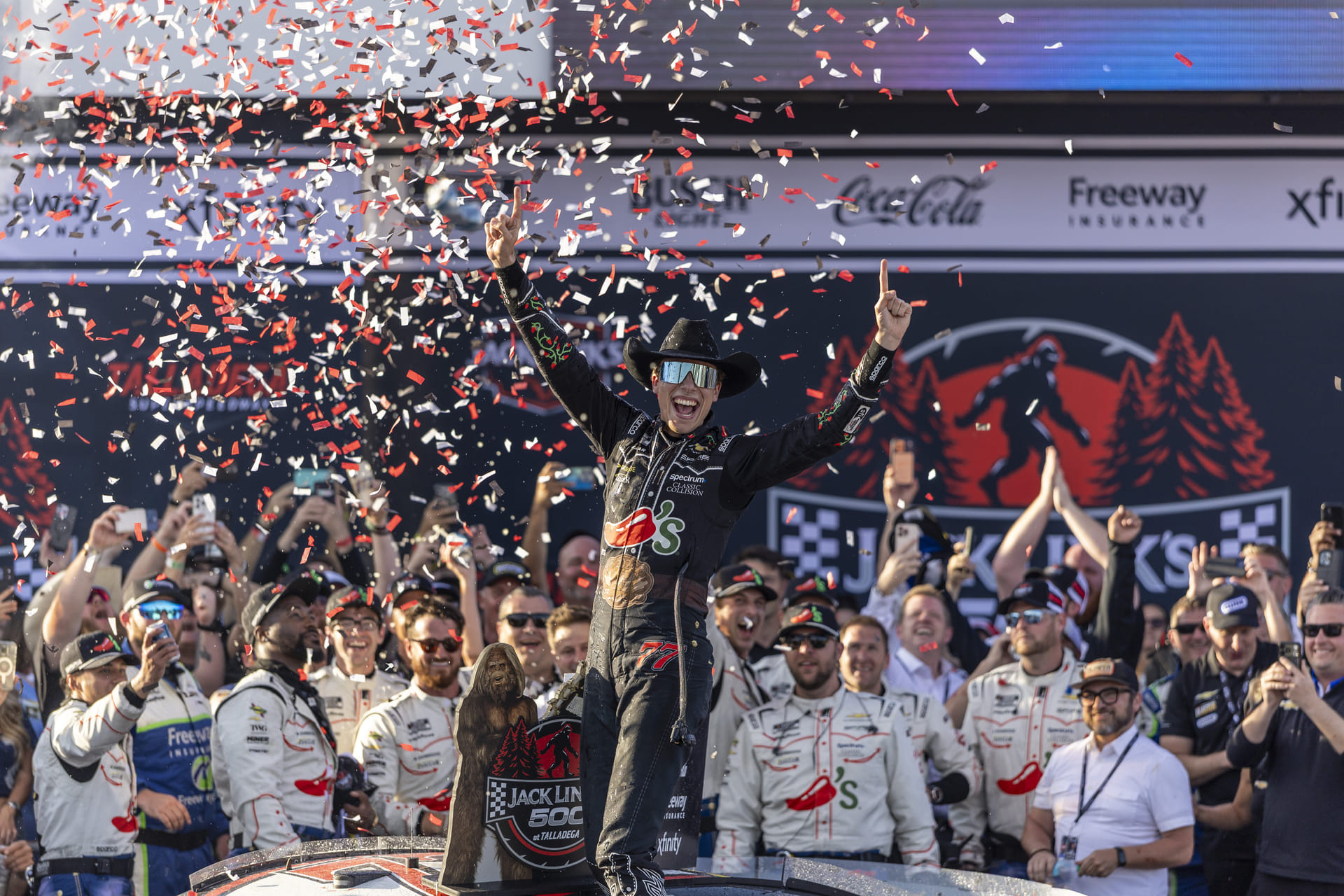
Carson Hocevar’s first Cup win was defined by his celebrations. After taking the checkered flag, he climbed onto the window of his No. 77 Chevrolet and drove while sitting halfway outside the car. It took multiple attempts to get moving cleanly, and he even drifted toward the infield barriers before correcting the car.
Once he found control, Hocevar drove along the frontstretch, sitting on the window, waving to the fans. He followed that with a burnout against the wall, still sitting on the window, before climbing out and celebrating on top of the car. It ended with him climbing on the frontstretch barrier and grabbing the checkered flag.
Steve O’Donnell reacted to the celebration, noting the obvious risk.
“I would not like to ban it. The only thing that got me a little bit was when he hit the wall at the end, it was pretty big jolt. But separate from that, I thought it was really cool. He takes a lot of grief, but he gets out there and races. He is who he is. We’ve always said, and the fans have always said, they want personalities, and I thought it was terrific. What he did was unique. You could hear it from the fans. I’m just really happy for him and really happy for Spire,” Steve O’Donnell said on the podcast (1:54 onwards).
Steve O’Donnell, who has spent three decades within NASCAR across multiple roles, now begins his tenure as CEO with that balance in focus.
Edited by Parag Jain