
Don’t let Trump’s blowup on NBC’s Meet the Press distract from what he actually said.
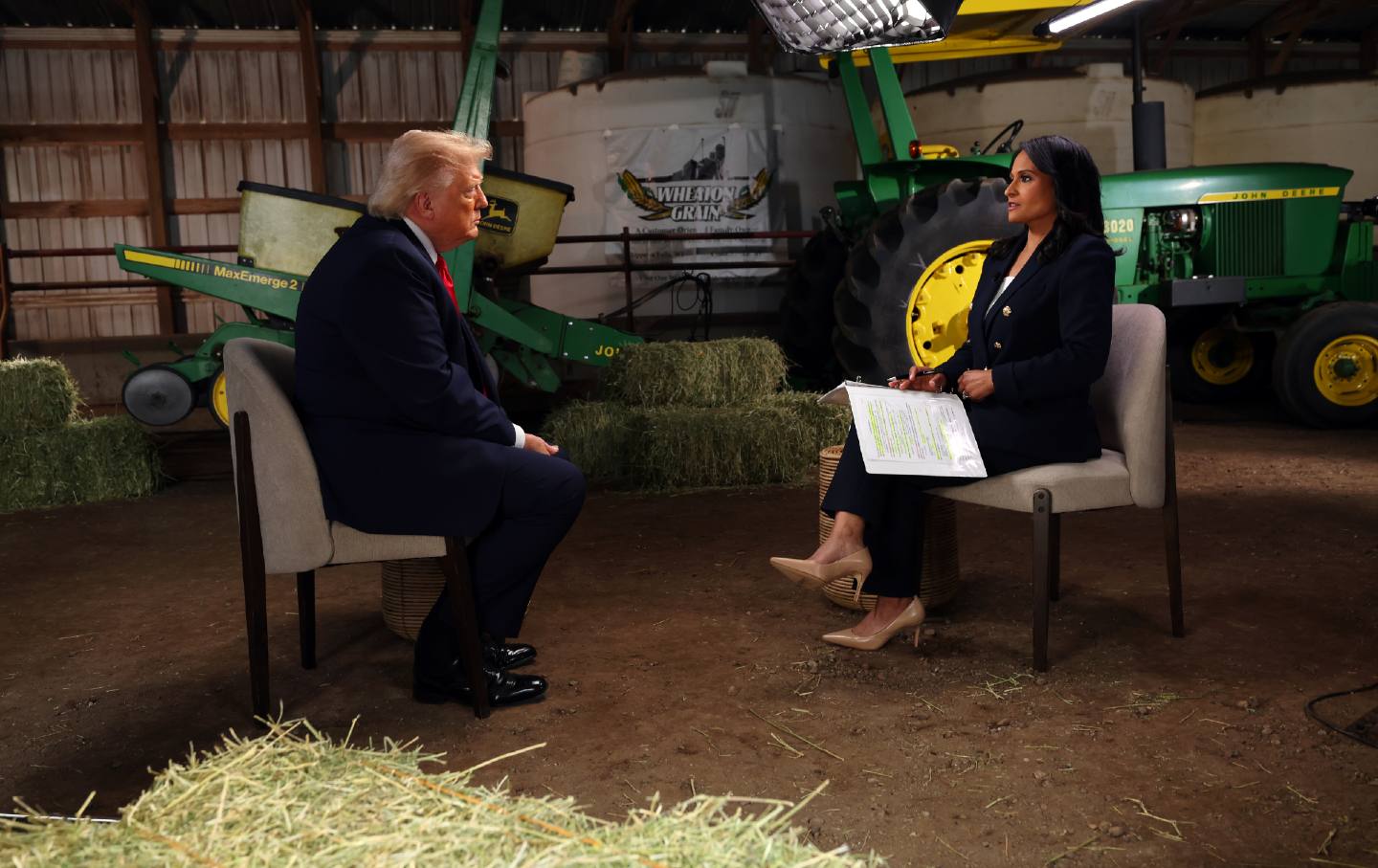
President Donald Trump sits down with NBC News’s Kristen Welker on June 5 in Wisconsin.
(Adam Bettcher / NBC via Getty Images)
When President Donald Trump abruptly broke off his interview with NBC White House correspondent Kristen Welker on Meet the Press, the consensus among the commentariat was that Trump was once more acting out of hair-trigger pique and poor impulse control. The exchange “was explosive” and “heated”; the aggrieved president “stormed off” into a cloud of paranoid conspiracy theories about the media’s collusion with Democratic-engineered election theft.
Such accounts fit a common template of coverage during Trump’s second term: The president, never an avatar of calm, reasoned judgment, is increasingly in thrall to wild mood swings and tantrums—when, that is, he’s not falling asleep on the job after a late-night bout of online shit-posting.
Yet there’s always been ample calculation in Trump’s shows of grievance and outrage, and Sunday’s performance was no exception. It’s important to underline this given the context for Trump’s outburst: Welker’s insistence that Trump’s multiple allegations of rampant election fraud carried out by his political opponents have no basis in fact. In grouping this under the vague and ever-pliant heading of “Trump unhinged,” our keepers of public discourse are repeating the miscalculation that they made in the run-up to the failed coup attempt on January 6: By failing to account for Trump’s theatrics as anything more than the latest flourish from an old man predisposed to shouting at a cloud, they’re missing the urgent and disturbing effort to discredit an election that will serve as a referendum on Trump’s performance.
To grasp this point, we must pan back from the decontextualized presentation of “takeaways” from Trump’s interview with Welker and consider the full exchange. Trump’s belligerent replies to Welker’s correction of his false election claims came near the end of a 40-minute interview, which proceeded along remarkably equable lines—especially by the standards of Trump’s usual run-ins with mainstream press reporters, particularly those who are women.
More than half of the sit-down was devoted to Trump’s assessment of the Iran War and prospects for an agreement to end the conflict; seeming to relish the role of a diplomatic power broker, Trump described what he considered the successful US campaign to “decapitate” the leadership of the Iranian regime and to lay waste to its military resources. He also claimed, for the umpteenth time, that the United States is on the verge of a lasting peace deal with Iran—while also holding out the prospect that he could unilaterally bomb the country into submission. After claiming to have masterfully maneuvered Iran’s leaders into the framework of an agreement, he said they would sign “or I’m gonna blow the hell out of them.”
Current Issue
This was all Trump’s usual fact-challenged bluster about his handling of the war, but apart from a stray swipe at opinion polling (“They’re all fake polls, especially yours,” Trump told Welker) and a drive-by characterization of Welker as “a big progressive,” Trump mostly projected a statesmanlike calm (once more grading on a curve) through most of the interview, hailing his own supposed breakthroughs in negotiations and contrasting the timeline leading to the conclusion of hostilities to the quagmires in Vietnam and Iraq.
Then there was the weird series of weather and technical delays that extended the scheduled taping of the exchange. Trump had invited Welker to interview him after an appearance in Wisconsin to shore up support in the beleaguered Midwest farm economy. As they sat in a corrugated tin shed in front of a prop John Deere tractor, the skies opened up, and the torrential rain made it difficult for the interlocutors to hear each other. They paused repeatedly for several minutes to let the rain let up; on another occasion, taping difficulties prompted a similar delay. Through the foul-ups, Trump maintained his generally even keel, marveling about the downpour and joking about the delays—scarcely the temperament of a guy hell-bent on blowing up the whole proceedings.
Trump’s talk became more overtly warlike when the discussion turned to domestic politics—though even then his tone didn’t modulate much. When Welker asked him about the status of his “so-called anti-weaponization fund” in the wake of acting Attorney General Todd Blanche’s announcement that the payoff scheme for January 6 rioters was dead in the water, Trump went into a tirade about the justice owed to victims of the “radical left lunatics that worked for the Biden administration and Sleepy Joe.” “People have been destroyed, many have committed suicide. Think of it, people have committed suicide because of a bunch of thugs went after them.”
If one were to actually think of it, of course, that phrasing is a far more apt description of the police officers victimized by the mob at the US Capitol than of the brownshirts seeking to install Trump as a dictator. But Trump was eager to revisit all the hits from the January 6 playlist, calling out James Comey—whom Trump fired more than three years prior to the insurrection—as “a dirty cop” and falsely claiming that FBI agents were leading rioters into the Capitol. As Welker patiently called out these falsehoods, Trump turned on her, saying she was “either crooked or stupid. You play right into their hands with this stuff. You know that these elections are rigged.”
In his trademark register of aggrieved customer demanding to talk to a manager, he claimed that Democrats are again seeking to rig the outcome of last week’s gubernatorial “jungle primary” in California because it’s taken more than five days to tally the votes—even though the lead GOP candidate, Steve Hilton, is poised to make it into the final runoff against Democratic opponent Xavier Becerra. Trump’s California charge is structurally identical to his claims that election night counts were manipulated against him when large numbers of anti-Trump voters in urban districts were accounted for later in the evening because it takes longer to count votes in more densely populated jurisdictions. The claims were bullshit then, and they’re bullshit now. So it was no wonder that Welker’s decision to make that point against Trump’s bogus assertion that he knows about voter fraud “by looking” evidently provoked the president to cut the interview short. Even then, however, he hadn’t “stormed off” or otherwise erupted; when Welker asked him to stay because she had flown out to Wisconsin to the sit-down, he countered that he’d been sitting with her for an hour in the rain—before signing off with, “Sorry. Let’s call it quits because I’ve had enough. Thank you, darling. Have a good time.”
Yes, this was condescending, patriarchal Trump-speak, but it was hardly a devastating breach in White House media relations, as Welker confirmed from her perch in the NBC studio; in a followup exchange with the president, she recounted, they both agreed that the weather delays had created difficulties for the exchange and that there’d be a follow-up interview for the show at a later date. That all gave the lie to Trump’s fulminations over the “crooked” state of things at NBC and how “a country can never be great with a dishonest press.” (On Welker’s side, the closing blowup also served to dilute the memory of her disastrous debut on the show in 2023, with a Trump interview that left a series of trademark flagrant Trump lies unchallenged, including several whoppers about January 6.)
Why did Trump shift so rapidly to outrage before the NBC cameras? We can rest assured it wasn’t due to the controlled diplomatic prowess he always claims to be training on his counterparts across the negotiating table in Iran. No, Trump’s outburst allowed him to use a major network platform to cast unfounded suspicion on the vote in California, which happens also to be dominated by the Democratic Party. And in doing so, he once more got the rest of the punditocracy to focus on his allegedly erratic personal bearing—and not his election lies. Without missing a beat, Trump’s lickspittle speaker of the House, Mike Johnson—the ardent House member who strategized with the Trump White House to get a vote before Congress to upend the results of the 2020 on January 6—has taken up the same claim that the California voting count must be crooked because of… vibes. “Look, some of these efforts are so diabolical and so far upstream it’s impossible to prove,” the addled lawmaker explained to reporters on Monday. “But I think everybody knows instinctively that something is wrong here.”
By throttling Kristen Welker in the style of a professional wrestler, Donald Trump short-circuited the country’s public discourse in a way that a fierce Midwestern thunderstorm never could. After such a gratifying afternoon’s work, why on Earth wouldn’t he come back for more?
With the midterm elections now firmly upon us, the question is whether Democratic candidates will do more than merely occupy ballot lines as mild alternatives to the red-hot crisis that is Donald Trump.
As Trump spends over $1 billion a day on a globally destabilizing war on Iran and admits that he doesn’t “think about Americans’ financial situation,” millions across the country are struggling with the surging costs of essentials. Democrats must seize this moment and advance bold, small-“d” populist ideas—not settle for cynical caution that once again snatches defeat from the jaws of victory.
The Nation elevates progressive ideas, movements, and elected officials achieving real change across the country into the national conversation. At the same time, our journalists are exposing how crypto and AI-funded super PACs are spending hundreds of millions of dollars to knock out candidates they oppose, reporting on the devastating impact of the Supreme Court’s evisceration of the Voting Rights Act, and sounding the alarm on attempts by red states to quickly redraw electoral maps, disenfranchising Southern Black voters.
We can play this critical role because of support from readers like you. This June, we’re raising $20,000 to power The Nation’s independent journalism in the run-up to November’s immensely consequential elections.
It’s in our power to build a more just society, and your support at this critical moment brings us closer to that bold vision. I hope you’ll donate today.
Onward,
Katrina vanden Huevel
Editor and Publisher, The Nation


